Week 23: Low Heart Rate Variability (HRV) with Low Heart Rate: What Does it Mean?
On parasympathetic saturation and normalized HRV.

Hi there 👋
I have received the following question on the relationship between HRV and HR, wondering how to interpret the data when things are a bit less straightforward than the typical e.g., increase in HRV with a reduction in resting HR or the other way around:
“For the first time in one of my professional athletes, I’m seeing an HRV / HR trend (nighttime measurements) that seems unusual to me and that I’ve never observed before in other athletes: HRV is decreasing, while resting HR remains stable and/or is actually decreasing further. For example, today I observed one of the lowest HRV values ever for this athlete, but at the same time one of their best resting HR values. How should I interpret this?”
I think we have at least two situations to consider here, with different outcomes, which we can try to better understand using some of the tools we have built in HRV4Training Pro: parasympathetic saturation (i.e., there is no issue with the athlete, but the data is not representative of autonomic activity) and actual fatigue. (we have an issue with the athlete’s stress response).
Parasympathetic Saturation
Parasympathetic saturation refers to a situation in which parasympathetic activity is particularly high, but this is not reflected accurately in HRV data. As Kiviniemi et al. explain, “possible physiological mechanisms underlying saturation could be due to the dose response of the heart to the acetylcholine secreted by vagal nerve ending. The dose response to acetylcholine has been considered to be linear until its concentration reaches the level at which a further increase in acetylcholine concentration does not produce a change in the response” - which means that despite an increase of parasympathetic control on heart rhythm, HRV does not increase. This is a positive state for the athlete, as stressed by my dear friend Daniel Plews: “in some circumstances, such as vagal saturation, decreases in cardiac parasympathetic indices of HRV during this particular training phase can be related to positive performance outcomes and consequently reductions in HRV, so should not be viewed negatively”. Parasympathetic saturation is not a problem physiologically; it is a situation in which the measurement does not reflect autonomic nervous system activity.
How do we avoid the issue of HRV data not being representative of parasympathetic activity due to saturation? We can take care of this under most circumstances by using a good protocol (i.e., not using a wearable).
In fact, parasympathetic saturation is one of the reasons why I stopped measuring my HRV while lying down, and started measuring while sitting. If you switched as well, and your HRV is higher when sitting, it is possible that the data was saturated when lying down (as you would otherwise expect the opposite, with higher HRV when lying down with respect to sitting or standing). As sitting adds a little stress, it becomes less likely that you encounter a situation of saturation.
Please see this blog if you’d like to learn more about measurement position and why sitting is in my view the ideal position for HRV measurements.
What can you do about it?
Depending on how you measure your HRV, you could be proactive and collect data that is less likely to be affected by the issue of parasympathetic saturation.
In particular:
if you measure your HRV during the night, there isn’t anything you can do. Hence you should use the procedure below (diagnostic plots) to determine if parasympathetic saturation is likely in your own case. If there is a weak correlation between resting heart rate (or RR interval length) and HRV, it might be preferable to use a morning measurement.
If you measure in the morning, you can measure while sitting (or standing), so that you add a little stress on your body and potentially prevent the issue of parasympathetic saturation, as recommended by Andrew Flatt.
Use HRV4Training Pro to determine the likelihood of parasympathetic saturation for you and your athletes
If you are in a period of high training load and HRV is low, together with low heart rate, and therefore the correlation between HRV and the average RR interval length is small or negative, parasympathetic saturation is plausible.
We have developed a feature in HRV4Training Pro to help you analyze this relationship. In the plot below, you would see the darker dots in the lower right corner (low HRV, low heart rate or high RR interval length). In this case, the suppression in HRV should not be interpreted negatively, as reported by Plews et al.: “the lack of correlation between the R-R interval and Ln rMSSD indicate that athletes are more likely to undergo parasympathetic saturation”.
You can find the plot below under Insights / Resting Physiology in HRV4Training Pro, we also report the correlation between HRV and the RR interval length for the past 2 and 6 weeks, so that you can more easily spot any recent changes.
In this first example, you can see a high, positive correlation between HRV and RR interval length, both over 2 and 6 weeks:

In this second example, the correlations are lower, but still positive:

Saturation would likely show no correlation (near zero, as shown in Daniel Plews’ paper).
Actual Fatigue
An alternative scenario, especially if we were measuring in the morning, exploiting the orthostatic stressor (i.e. while seated or standing), and given a certain context, for example, a high training volume/intensity block, could be that we are indeed accumulating fatigue, and we are simply interpreting heart rate data incorrectly.
As a matter of fact, fatigue often manifests as a suppression in our physiology, and when this happens acutely, it should not be interpreted as a positive sign (i.e., while we might want heart rate to slowly reduce over months as our cardiorespiratory fitness improves, because of cardiac remodeling for example, an acute change in resting heart rate is unlikely to happen because fitness suddenly improves, and is often tied to fatigue).
Context will help us here, but there are fatigue patterns that are a good match with what is described in the initial question, i.e., suppressed heart rate, and HRV that remains normal or gets also suppressed. Keep in mind that heart rate and HRV are not the same thing (or the inverse of one another) and HRV is more sensitive to stress than heart rate, hence training stress, which is more subtle than e.g. sickness or other stressors that have a large impact on resting heart rate, might be reflected only in HRV data at times, which is why we go through the trouble of measuring it. This means that we should pay attention to these suppressions in HRV even if heart rate is normal, and possibly we should pay even more attention to suppressions in HRV when heart rate is lower than normal, which might be an additional signal that we are accumulating fatigue.
Normalized HRV in HRV4Training Pro
A good way to look at the data in these cases is by combining HRV and heart rate, using what I have called Normalized HRV, which you can also find in HRV4Training Pro.
As I’ve discussed in a dedicated blog, the most important question for me is this: does normalization of HRV by heart rate improve the actionable insights we derive from HRV data? My current take is that the answer is yes, especially if we have a stable or below normal heart rate, which could be the case in many situations (e.g. dieting, but also cold exposure, accumulated fatigue, or higher parasympathetic activity associated with fatigue, more than recovery).
A recent paper by Bulte et al., looked at Normalized HRV in relation to training load in state and international-level swimmers, concluding that it “may provide a more comprehensive evaluation of an athlete’s physiological status compared with a sole parasympathetic modulation or tone marker“ - given their results in which Normalized HRV was the only parameter that correlated with training overload (while heart rate or HRV didn’t).

Alright, that’s all for today on parasympathetic saturation and fatigue, I hope this was informative. As you can tell, in both cases, additional context is key for data interpretation (e.g., training load, individual responses to previous blocks, other life stressors that are not training related, as well as subjective feel). On top of that, make sure to use good protocols and good tools, and the interpretation of the data will also be easier.
Cheers.
Personal Coaching for Runners
Please apply here should you be interested in working with me.
You can also learn more about my coaching, here.
Thank you!

The Book
Our book is out and available for purchase from Human Kinetics’ website, here (or on Amazon).
HRV4Training Pro
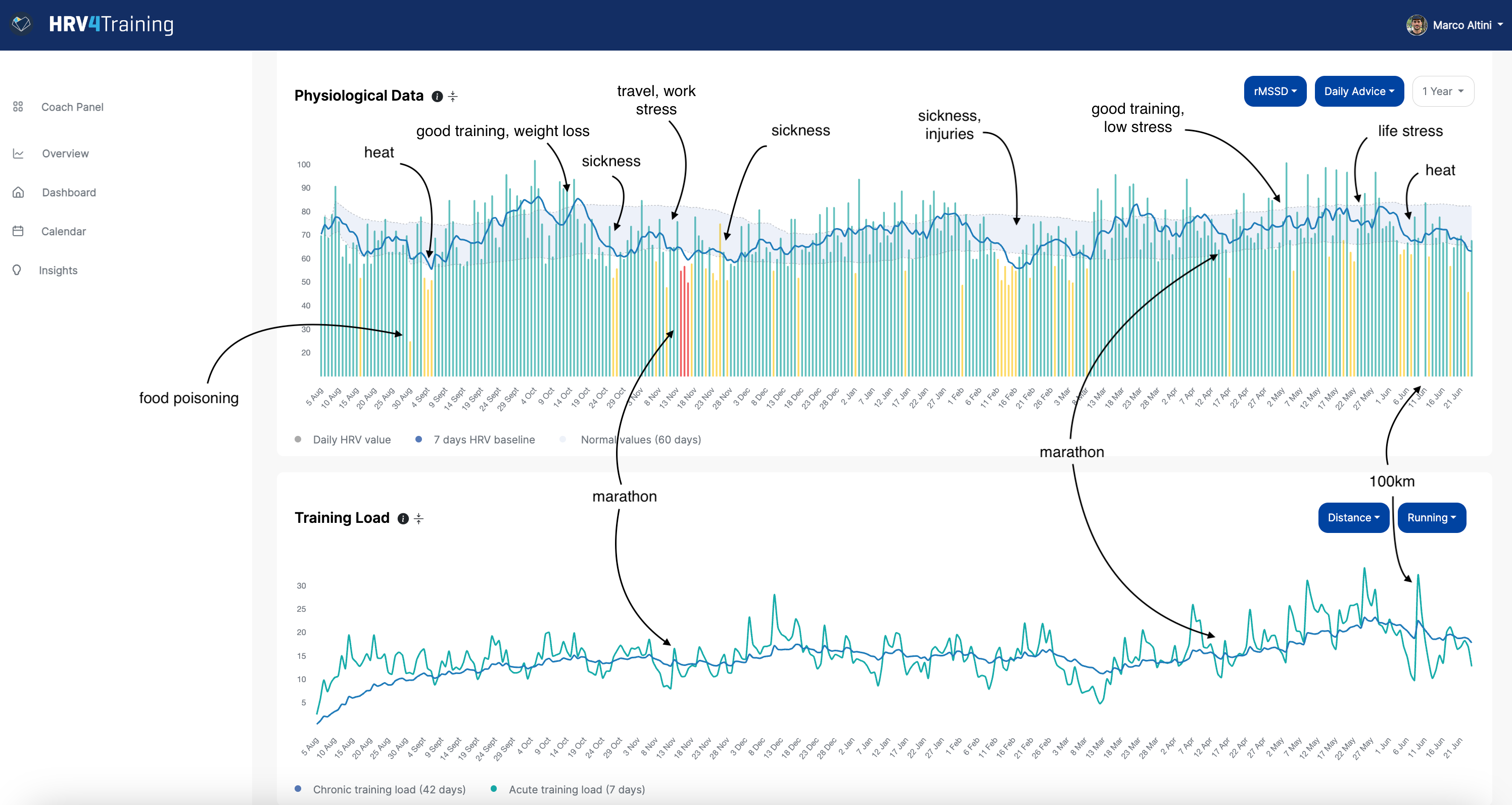
HRV4Training Pro is the ultimate platform to help you analyze and interpret your physiological data, for individuals and teams.
You can find a guide and overview here.
Try HRV4Training Pro for free at HRVTraining.web.app
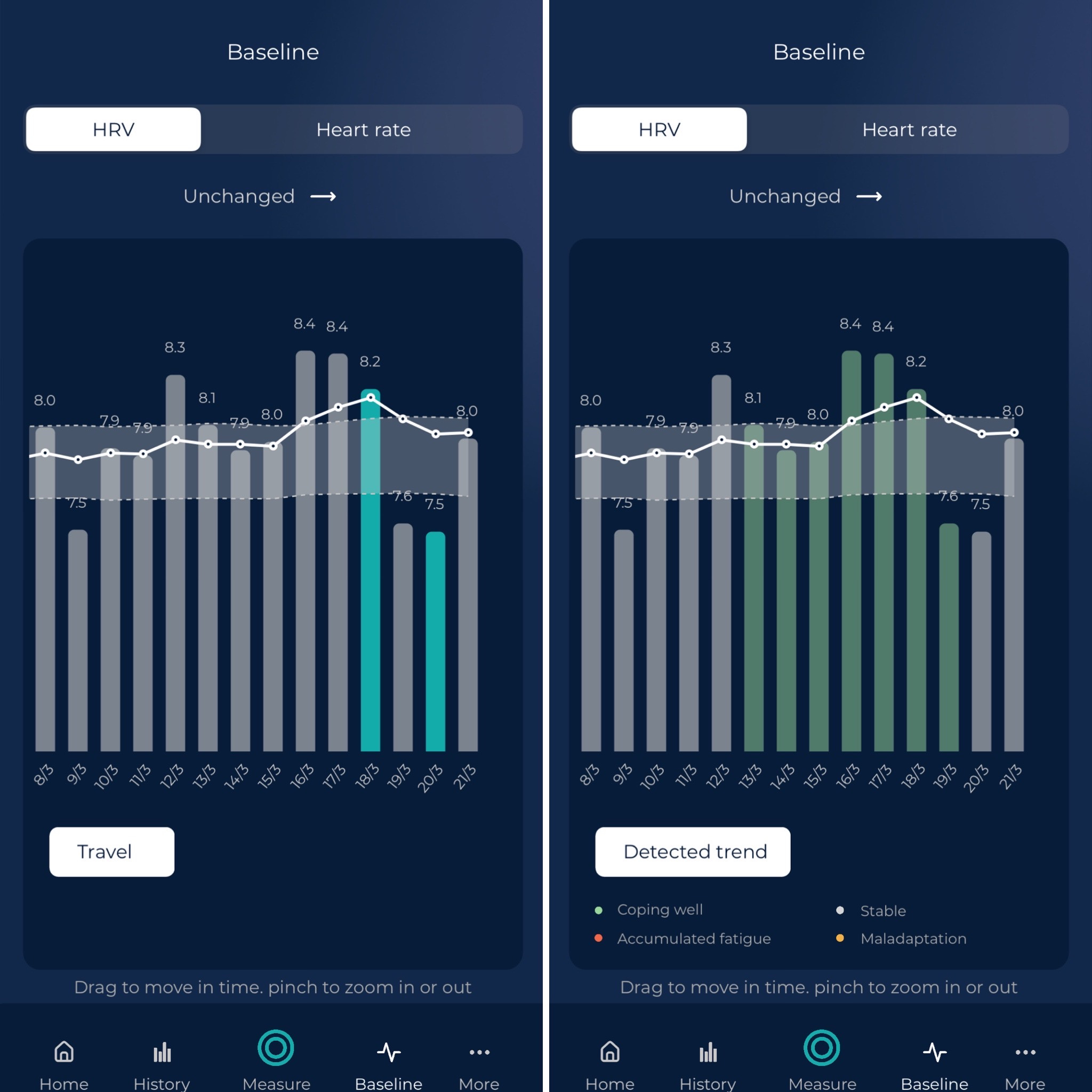
When using Pro, the app will also automatically recognize your account and add the Normal Range to the Baseline view, together with detected trends and additional annotations, which can help contextualizing longer-term changes.
You will also be able to pick rMSSD as the parameter to see on the homepage of the app.
Thank you again for your support and for allowing us to remain independent.
See you next week!

Marco holds a PhD cum laude in applied machine learning, a M.Sc. cum laude in computer science engineering, and a M.Sc. cum laude in human movement sciences and high-performance coaching. He is a certified Ultrarunning Coach.
Marco has published more than 50 papers and patents at the intersection between physiology, health, technology, and human performance.
He is co-founder of HRV4Training, Endurance Coach at Destination Unknown, advisor at Oura, guest lecturer at VU Amsterdam, and editor for IEEE Pervasive Computing Magazine. He loves running.
Social:
Personal Substack
Strava
Instagram