Week 10: Aerobic Efficiency Analysis Update

Hi there,
I hope everything is well.
I’ve added more activities to the Aerobic Efficiency analysis in HRV4Training Pro, to help you keep better track of progress in the short-medium term.
In case you are new to this feature, here is how it works: to determine your aerobic efficiency we compute the relation between output (pace) and input (heart rate).
Intuitively, a lower heart rate for the same pace, when consistently shown over periods of weeks, translates into better aerobic efficiency. Good endurance athletes tend to have high aerobic efficiency, meaning that they can sustain a relatively high workload (for example pace or power), at a relatively low effort (typically measured in terms of heart rate). Similarly, a higher power or faster pace at the same heart rate is linked to improved aerobic efficiency. By analyzing the relationship between input and output for running or cycling activities, you can easily track aerobic endurance changes over time, as you progress with your training.
Note that there is no ideal (absolute) value when it comes to aerobic efficiency, the whole point is to track progress relative to your historical data and to see how training is progressing.
Below is an example in which I have filtered for zone 2 efforts, as I ran the same route once per week for several weeks, while rebuilding with my training. The analysis captures progress in terms of a faster pace for the same heart rate, in this case:

While aerobic efficiency is in arbitrary units, it can be interesting to see how things change in the medium or long term (these changes would show how cardiorespiratory fitness changes, as in the image above), but also acutely after an effort (these changes reflect fatigue). For example, below, after a marathon, we can see that aerobic efficiency is reduced for the following day’s run, due to fatigue, and things improve a bit the following day.

You can use the same approach to evaluate the effect of environmental stressors such as the heat or altitude, and keep track of the adaptation process.
Keep in mind that are many factors that can affect the relationship between pace (or power) and heart rate. For this reason, you can choose what data is used to track changes in aerobic efficiency. In particular, via the panel below, you can filter workouts so that the resulting data is more representative of the changes you are interested in.
In particular, you can configure the analysis based on a number of parameters related to the workout, internal load, and environmental conditions:

Pro will show you which workouts are filtered for the last time window included:

I hope you’ll like the new Aerobic Efficiency Analysis update and the improvements we implemented.
You can try them here.
Thank you for your support!
Discount for HRV4Training Pro: 20% off 🖥️
HRV4Training Pro is the ultimate platform to help you analyze and interpret your physiological data, for individuals and teams.
You can find a guide and overview here.
Try HRV4Training Pro for free at HRVTraining.web.app or use promo code SCIENCE for 20% off.
While we really appreciate the pledges on Substack, our writing here will always remain free, and Pro is the best way to support our work.
I thank you for that.
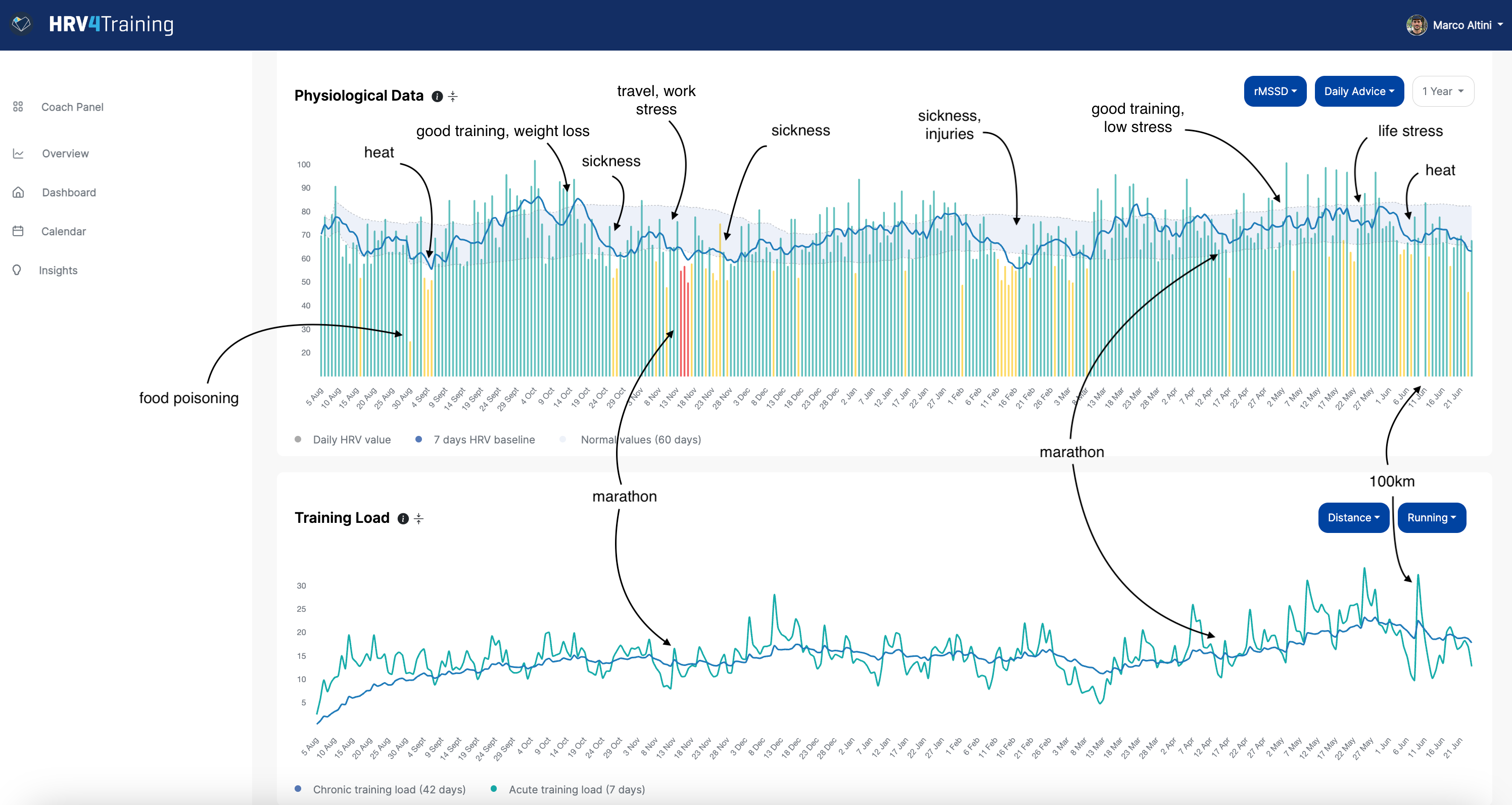
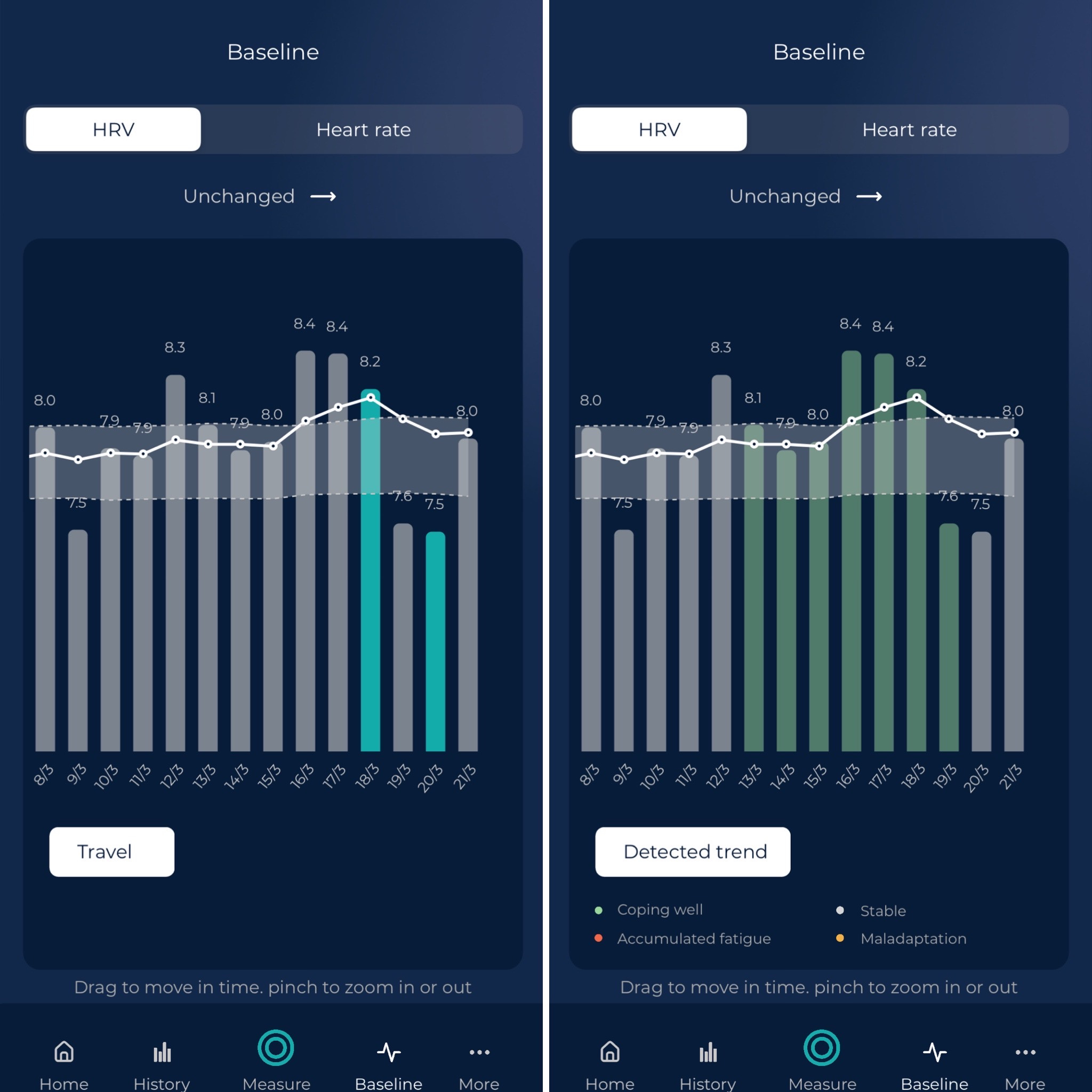
When using Pro, the app will also automatically recognize your account and add the Normal Range to the Baseline view, together with detected trends and additional annotations, which can help contextualizing longer-term changes.
You will also be able to pick rMSSD as the parameter to see on the homepage of the app.
See you next week!

Marco holds a PhD cum laude in applied machine learning, a M.Sc. cum laude in computer science engineering, and a M.Sc. cum laude in human movement sciences and high-performance coaching.
He has published more than 50 papers and patents at the intersection between physiology, health, technology, and human performance.
He is co-founder of HRV4Training, advisor at Oura, guest lecturer at VU Amsterdam, and editor for IEEE Pervasive Computing Magazine. He loves running.
Social: